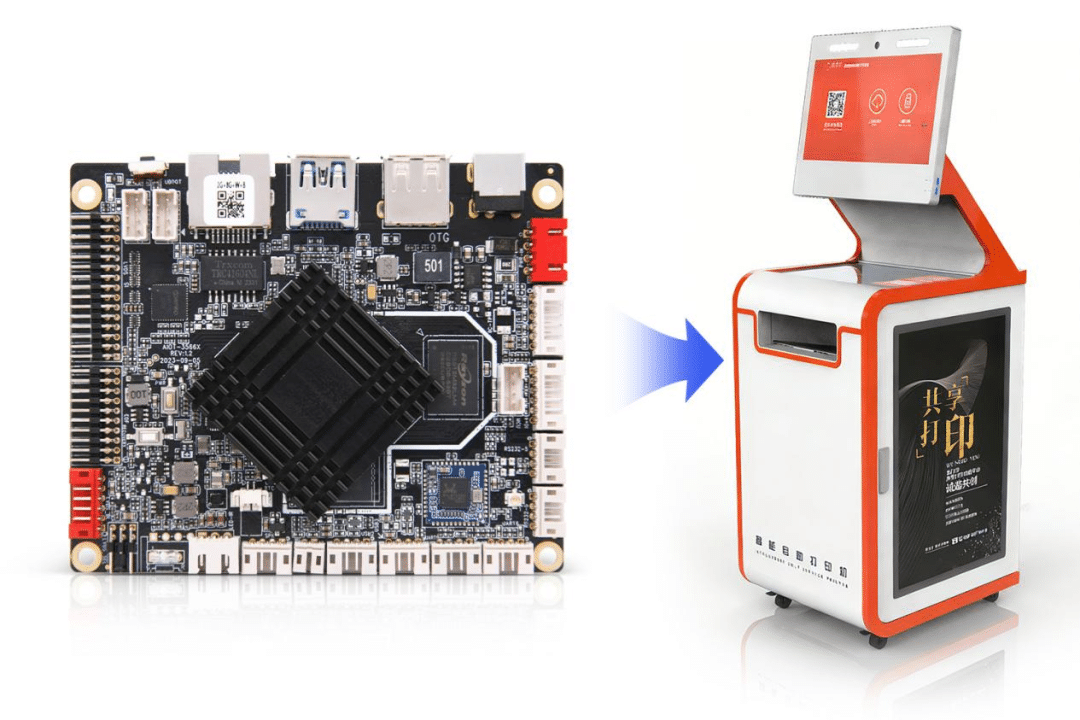
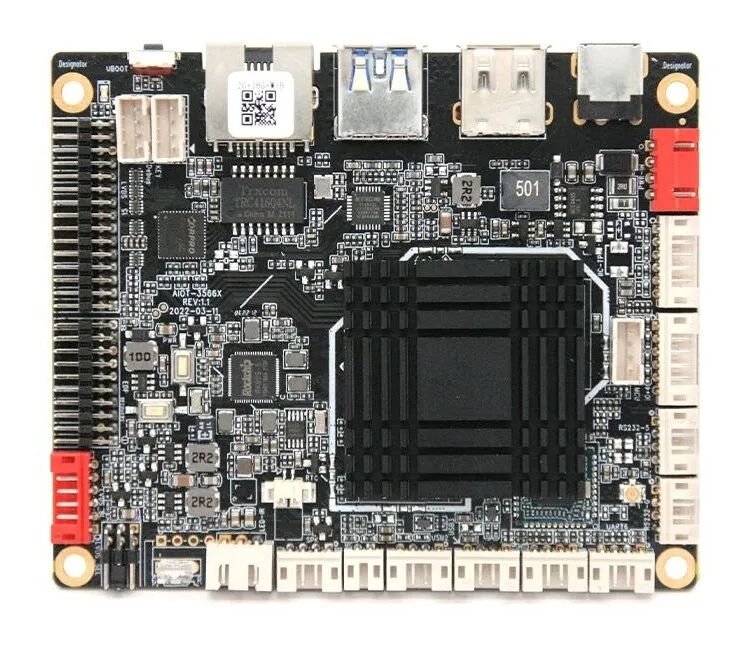
The rapid growth of unmanned and self-service solutions has driven the explosive expansion of the shared printer market. Today, these smart terminals must deliver superior intelligence, reliability, and scalability to meet high-concurrency, multi-functional business demands. Our partner selected the ShiMeta AIoT-3566X Quad-Core Smart Terminal Motherboard as the core control unit to build a high-performance, reliable printing service platform.
Shared printer terminals face complex operational requirements:
Complex Interaction Processing: Seamless operation of HD touch UI while simultaneously handling background print jobs, mobile payments, and voice prompts
Real-Time Performance & High Concurrency: Instant response to touch operations, network communication, peripheral control (printers, cameras), and content security detection
Rich Extension Capabilities: Connectivity with multiple peripherals including printers, HD cameras, ID card readers, and USB interfaces
Stringent Stability Requirements: Commercial-grade 7×24-hour continuous operation with remote monitoring and maintenance capabilities
Why AIoT-3566X is the Ideal Solution
The ShiMeta AIoT-3566X motherboard delivers exceptional performance for shared printer applications:
1. Powerful Core, Performance Foundation
Processor: Rockchip RK3566 Quad-Core ARM Cortex-A55 CPU @ 1.8GHz delivers robust computing power for advanced applications
NPU: Integrated 1TOPS neural processing unit enables local AI features like “smart portrait detection and instant background replacement,” reducing cloud dependency
OS: Android 11.0 default (supports Linux and OpenHarmony), with open API reference codes for seamless custom APP development
Display & Imaging: Supports MIPI, LVDS, and eDP display interfaces for various HD screens. Dedicated MIPI Camera interface supports 8MP front camera for “ID photo capture”
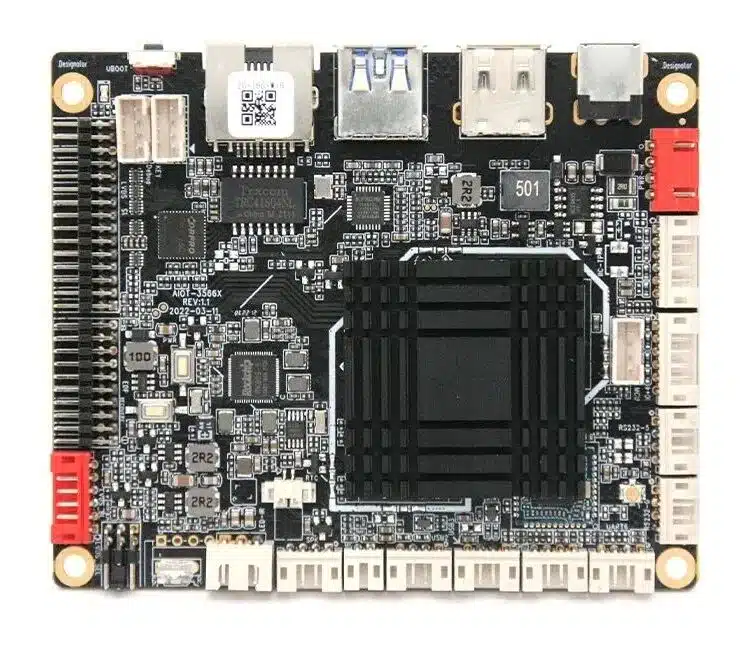
Expansion & Connectivity: 4 USB ports including USB 3.0 for simultaneous connection of printers, USB drives, and ID card readers. Multiple RS232/TTL serial ports and GPIO for custom peripherals. Built-in Wi-Fi and 100Mbps Ethernet enable “data roaming” and remote management
Industrial-Grade Design: Compact form factor (100x83mm) for easy integration
RTC Support: Real-time clock ensures accurate task scheduling and logging
System Upgrade: Complete OTA update solution for long-term commercial deployment
In today’s IoT and smart hardware era, a powerful, reliable, and open core hardware platform is essential for successful innovation. The ShiMeta AIoT-3566X motherboard — with its quad-core CPU + dedicated NPU heterogeneous computing, comprehensive interface design, and industrial-grade stability — perfectly meets the demands of complex smart terminals like shared printers.
Choose AIoT-3566X as your high-performance, cost-effective core solution for smart service terminals.
Frequently Asked Questions
What processor does AIoT-3566X use?
The AIoT-3566X features the Rockchip RK3566 quad-core ARM Cortex-A55 processor @ 1.8GHz, delivering powerful computing performance for smart terminal applications.
Can AIoT-3566X support shared printers?
Yes. The AIoT-3566X is specifically designed for self-service kiosk applications. Its comprehensive I/O interfaces (USB 3.0, RS232, GPIO) and industrial-grade reliability make it ideal for shared printer deployments.
Does AIoT-3566X have AI capabilities?
Yes. The integrated 1TOPS NPU enables local AI processing for features like portrait detection, background replacement, and face recognition—reducing cloud dependency and latency.