


SoC vs SoM vs SBC: Key Differences and How to Choose the Right Solution
In embedded system design, choosing between a SoC, a SOM, and an SBC is an important choice. Depending on the needs of your application, each has unique benefits, from edge computing and industrial control to smart gateways and medical devices. To assist you in selecting the best option for your particular project, this article contrasts the architectures, features, and design concerns of SoCs, SOMs, and SBCs.
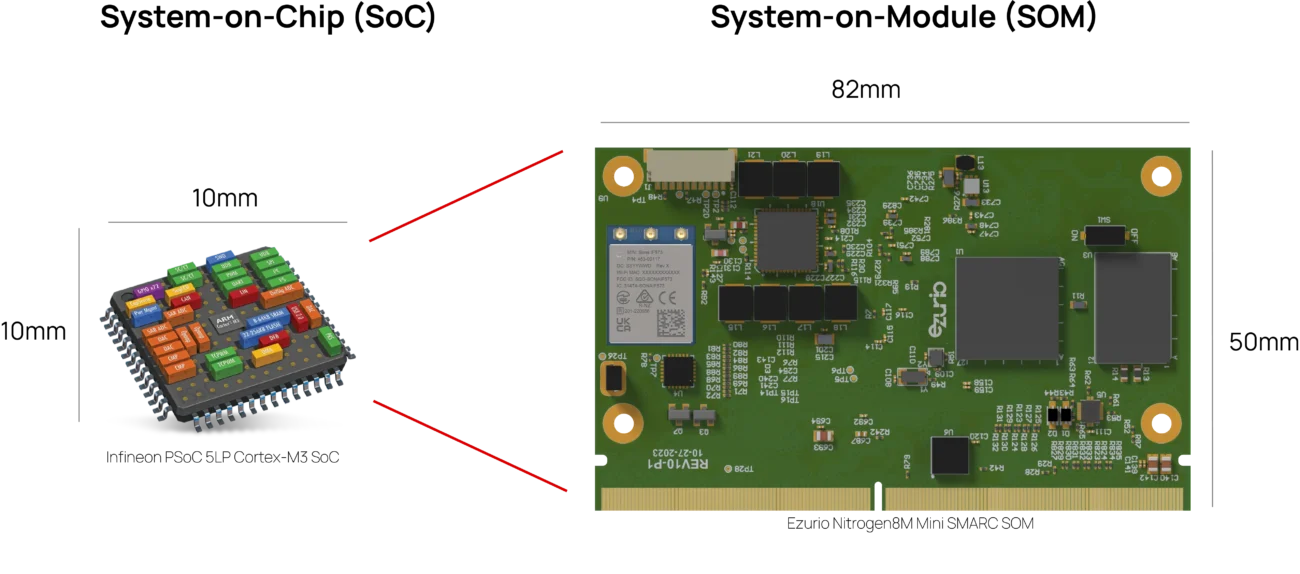
What is a SoC?
In essence, a system-on-a-chip (SoC) is a whole computer condensed onto a single integrated circuit. A single piece of silicon houses all the necessary parts, including the CPU, memory, input/output interfaces, and occasionally even wireless radios. Put otherwise, a SoC combines all the components required for computation onto a single chip, with the possible exception of a power source. An SoC can act as a device’s brain with few external components thanks to its high degree of integration.

Advantages of SoC
Integration: Saves electricity and board space by reducing the number of external components.
Performance Efficiency: Low latency and high efficiency are the results of optimization for certain use cases.
Cost Savings at Volume: In high-volume production, integration lowers BOM (Bill of Materials) expenses.
What is SoM?
A System-on-Module (SoM), which is a small board-level module that houses an entire computer system, goes beyond the idea of integration. In actuality, a SoM is a tiny circuit board that houses a SoC together with other auxiliary parts including wireless radios, memory, power management, and other connections. It functions as a tiny “computer core” that you can solder or insert onto a bigger board, also known as a carrier board, that has peripherals and ports tailored to a particular purpose. Crucially, a SoM needs a carrier board or baseboard to connect to the outside world; it is not a complete product on its own.

Advantages of SoM
Design Flexibility: For specialized or limited contexts, a custom baseboard offers exact control over layout, connectors, and functionality.
Modular Development: By facilitating reuse across several projects or product variations, SOMs shorten the time needed to build new designs.
Optimized BOM Cost at Scale: Optimizing the baseboard for a fixed feature set helps lower overall system costs in large-scale deployments.
What’s the differences: SOMs and SoCs
Flexibility and Integration
SoC: Offers the maximum degree of chip-level integration. Although it provides little flexibility, it allows for excellent efficiency and compact dimensions. Usually, a new chip or a whole hardware redesign is needed for any significant upgrade, such adding ports or increasing processing power.
SoM: Preserves modularity while providing strong board-level integration. Upgrading to a newer CPU or adding memory can frequently be accomplished by switching to a pin-compatible module because the module connects into a carrier board. Because of their adaptability, SoMs are perfect for rapidly changing industries including industrial applications and the Internet of Things.
Time-to-Market and Development Effort
Full hardware design, including high-speed routing, power management, RF architecture, and compliance testing, is necessary for SoC (Custom Design). High-volume production may benefit from longer and riskier development cycles.
SoM: The majority of sophisticated hardware has already been created and approved. The carrier board is primarily developed by engineers, which lowers risk and speeds up development. Product launch is further expedited by pre-supported OS images and drivers.
Cost Aspects
Development Cost: SoC designs require a large initial outlay of funds (engineering, PCB iterations, certification). Only at high production levels is this justified.
SoMs are appropriate for low-to-mid quantities since they eliminate a large portion of the complicated hardware design and certification process, which lowers the initial outlay.
Production Cost: In high-volume manufacturing, SoCs generally attain lower unit costs.
Although SoMs cost more per unit, when development savings are taken into account, they may be more cost-effective overall for moderate volumes.
Size, Power, and Performance
Extreme downsizing and low-power applications, including wearables, are frequently better suited for SoCs.
Performance disparities are negligible because SoMs typically have the same internal SoCs. In extremely limited designs, custom SoC architectures might, nevertheless, achieve marginally greater size and power optimization.
Lifecycle and Reliability
Reliability: By eliminating extraneous components, SoCs may increase the robustness of hardware.
Because SoMs are expertly created and tested, they frequently adhere to industry standards, which lowers design risk.
Lifecycle Support: Long-term availability (7–15+ years) and upgrade pathways are commonly offered by SoM suppliers.
Independent component obsolescence management is necessary for custom SoC designs.
In conclusion
SoC: Ideal for extremely high-volume devices that need to maximize power, size, and cost optimization.
SoM: The best for long-term maintainability, quicker development, lower risk, and simpler upgrades.
To put it briefly, SoMs optimize for flexibility and time-to-market, whereas SoCs optimize for scalability and efficiency.
Comparison Table: SoC vs SOM vs SBC
| Aspect | SoC (System on Chip) | SOM (System on Module) | SBC (Single Board Computer) |
| Core Components | CPU + GPU + RAM + I/O interfaces integrated on one chip | CPU, RAM, storage integrated in a compact module | CPU, RAM, storage + all essential I/O on a single board |
| Peripheral Connectors | Requires PCB design to access I/O | I/O exposed via custom-designed baseboard | I/O pre-installed and readily accessible |
| Flexibility | Maximum – hardware fully customized | High – baseboard fully customizable | Fixed – limited to onboard I/O |
| Development Effort | Very high – requires full PCB design and integration | Moderate – only baseboard needs to be developed | Minimal – plug-and-play |
| Scalability | High, but requires design reuse and engineering effort | Easy to scale via interchangeable SOMs | Limited – changes often require full redesign |
| Cost Efficiency | Best for ultra-high volume custom devices | Cost-effective in medium to high-volume applications | Best for prototyping or low-volume projects |
| Customization | Full control over hardware & layout | Flexible customization via baseboard | Limited – depends on available models |
Conclusion
It is crucial to consider the requirements and limitations of the project while deciding between a System-on-Module and a System-on-Chip. To choose the optimum solution, engineers must take into account variables including cost, adaptability, and intended use.