


DDR, indicates that the memory can send two data transfers in a single clock cycle. Dynamic random access memory (DRAM) that is synchronised with the clock speed for which the microprocessor is optimised is known as SDRAM, or synchronous dynamic random access memory.
DDR4 is the fourth generation of DDR SDRAM, and DDR5 is the fifth generation (often just called DRAM). Let’s start by defining those acronyms. The fifth generation of Double Data Rate (DDR) Synchronous Dynamic Random-Access Memory (SDRAM), known as DDR5, is an improvement over DDR4 that provides noticeably faster speeds, more bandwidth, and better energy efficiency.
| Specification | DDR4 | DDR5 |
| Bandwidth | Maximum 3200 MT/s | About 4800-5600 MT/s |
| Capacity | 32GB/module | Up to 128GB/module |
| IO Voltage | 1.2V | 1.1V |
| Bank Groups | 16 banks | 32 banks |
| Burst Length | 8 | 16 |
| Latency | Lower Latency | Higher Latency |
| Power Management | On motherboard | On Module |
| On-die ECC | Not standard | Available in some modules for better data integrity |
Bandwidth: 25.6 GB/s is the theoretical maximum bandwidth of DDR4-3200. A 64-bit data bus and 3200 MT/s transfer rates make it feasible. However, real-world applications may have less bandwidth because of latency and overhead. Although it can be a bottleneck in situations requiring a lot of memory, it is suitable for gaming.
Latency: At JEDEC standard speeds, DDR4’s CAS latency (CL) may be between 13 and 16. While typical DDR4 kits operate between CL16 and CL19, lower-latency kits can achieve CL13. Reduced latency speeds up real-time simulations and quick database queries. However, the latency of DDR4 may restrict its total performance.
Clock Speed: DDR4’s clock speed can range from 2133 to 3200 MT/s. 3200 MT/s is the maximum specified JEDEC speed for DDR4. Overclocked modules, however, can achieve 5000 MT/s. Recall that while these rates are adequate for the majority of general tasks, they are insufficient for complex data processing and high-resolution games.
Pros: DDR4 provides sophisticated technology that works with a variety of systems, including AMD’s 5000 series processors and Intel’s 10th. Because of manufacturing and availability, it is affordable. Furthermore, consumers who require stability without advanced technologies have a clear understanding of DDR4’s overclocking headroom.
Cons: DDR4’s reduced performance cap and future-proofing are its drawbacks. It offers less memory density and bandwidth than DDR5. DDR4 finds it difficult to handle next-generation workloads in AI, machine learning, and 3D rendering due to CPUs’ increased cores and computational requirements.
Latency: Compared to DDR4, DDR5 has a greater CAS delay, starting at 36. However, this higher CAS delay is offset by quicker clock rates. This indicates that the actual delay in nanoseconds is just somewhat greater than DDR4’s. For instance, DDR5-4800 CL40 may have a latency of around 16.67 ns, while DDR4-3200 CL16 may have a delay of 13.75 ns. As a result, the latency gap is reduced compared to what the CAS figures indicate.
Clock Speed: DDR5 has a base frequency of 4800 MT/s and can reach rates of up to 6400 MT/s. Higher overclocked modules might surpass 8000 MT/s in the future. Thus, greater data transfers per second can be handled by DDR5. For innovative processors with 16 cores or more, such as AMD’s Zen 4 CPUs and Intel’s Alder Lake, it counts.
Bandwidth: Theoretically, DDR5 can offer up to 51.2 GB/s (DDR5-6400). It is achieved with two separate 32-bit subchannels per module and doubles that of DDR4. It helps with AI calculations, real-time simulations, and 4K/8K video editing. Memory throughput is crucial to performance in this situation.
Pros: DDR5 provides higher memory density, supporting up to 2 TB in enterprise settings and 128 GB per module in consumer settings. Data centres, scientific computing, and content production all depend on it. Additionally, DDR5 runs at a lower voltage (1.1V) for heat control and power savings in servers that run continuously.
Cons: One of DDR5’s shortcomings is compatibility. Upgrades are expensive because it requires new motherboards and CPUs, such as AMD’s Zen 4 and Intel’s 12th Gen. Even though DDR5 prices have decreased, they are still more expensive than DDR4. In consumer workloads, early DDR5 modules don’t necessarily perform better than expensive DDR4 kits.
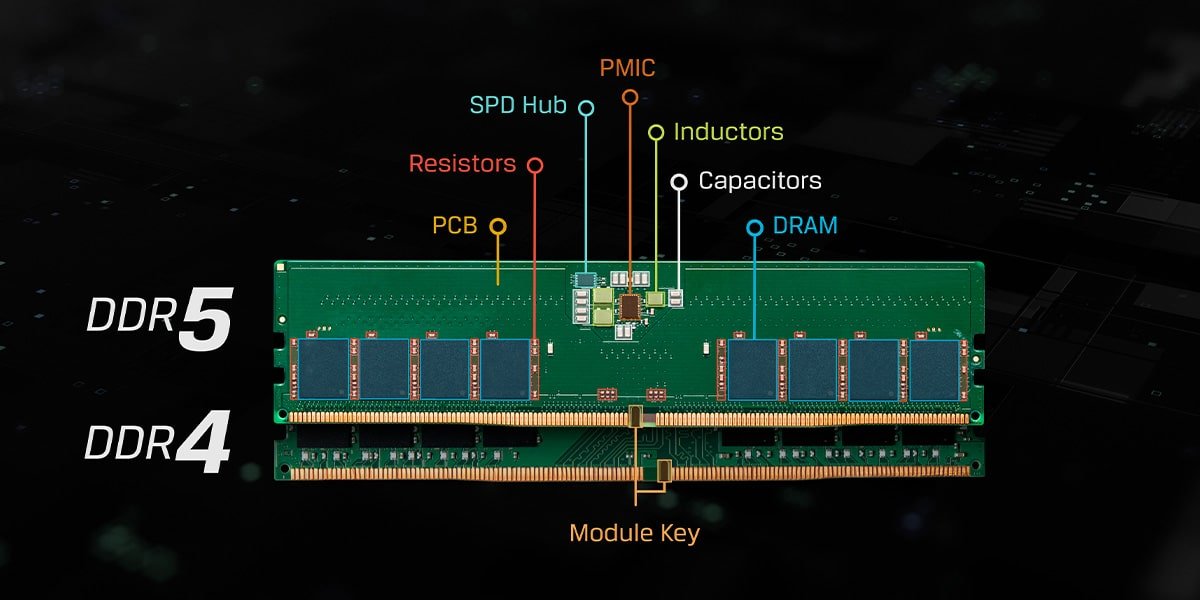
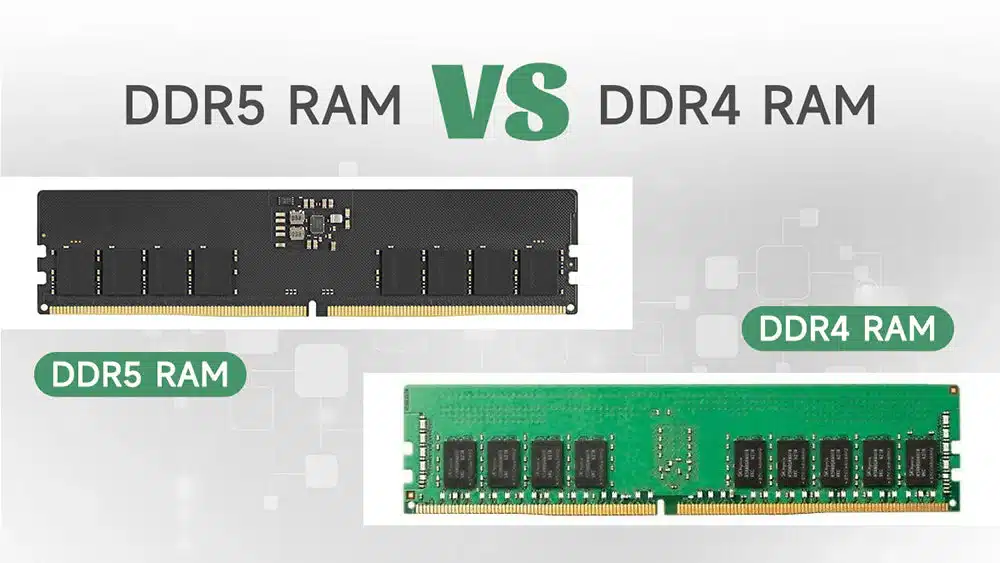
In terms of form factors, DDR4 and DDR5 continue to use the SODIMM (Small Outline DIMM) and UDIMM (Unbuffered DIMM) formats for laptops and desktop computers, respectively. However, DDR5 offers significant improvements. For example, DDR4 and DDR5 UDIMMs have different pinout architectures and power delivery even though they both have 288 pins. To physically prevent cross-compatibility, DDR5 employs a notch location. Additionally, DDR5 uses two 32-bit subchannels for access efficiency as opposed to DDR4’s single 64-bit channel.
The on-module Power Management IC (PMIC) in DDR5’s form factor modifies the approach to power control. Voltage regulation is transferred from the motherboard to the module. Previously handled by the motherboard in DDR4, the integration results in improved voltage regulation and reduced electrical noise. Additionally, SBRF and DDR5’s higher bank count (32 compared to DDR4’s 16) improve data access for high-performance computing scenarios.
There are far more horses behind the hood, even though the sticks might appear the same. The new starting point for DDR5 is 3,200 MHz, which is technically the maximum frequency for DDR4 processors. Although there aren’t many top-end examples available, DDR5 can sustain speeds as high as 8,000 MHz. However, most consumer DDR5 RAM caps out at 6,400 MHz, so don’t expect to add memory like that to your gaming setup anytime soon.
DDR5 had serious launch problems when it was originally released. The new technology was costly, hard to find, and integrated into relatively few gadgets. It wasn’t until late 2021 that the first consumer products using DDR5 were released. Private customers were initially uninterested due to the relatively minor improvements. But a lot has changed since then. The prevalence of devices utilising DDR5 RAM has increased dramatically, and the technology is now both more accessible and significantly less expensive. In certain situations, DDR5 is now more affordable than DDR4.
The generation of DDR SDRAM is indicated by the digits 4 and 5 in DDR4 and DDR5. The fourth and fifth generations of this memory technology are DDR4 and DDR5, respectively.
The typical speed range for DDR4 is 1600 MT/s to 3200 MT/s. DDR5 can operate at up to 8400 MT/s or faster, starting at 4800 MT/s.
No, a DDR5 slot cannot accommodate a DDR4 module. Because DDR4 and DDR5 have distinct physical keying, the modules’ notches are positioned differently to avoid improper installation. The right kind of RAM must be used in the memory slots on your motherboard.


